
Primary guidance and, where named, a dated issuer example support a distinct reader decision. Calculations are labelled illustrations; there is no universal product ranking or personalised recommendation.
Commercial status: There are no affiliate links in this edition. Providers did not pay for inclusion or approve this copy.
Start with the card statement you already have. Write down the balance and the monthly payment you can repeat, then test whether a 38-month balance transfer leaves you able to clear the new balance before the offer ends.
The transfer fee goes into that calculation from the start. A long advertised period gives you time, but it does not remove the fee or create money for repayments. This guide helps you build a small payoff worksheet using your own offer.
Write down the actual offer
Checked on 18 October 2026, TSB advertised up to 38 months at 0% on balance transfers, a 3.49% fee for transfers in the first 90 days and 24.9% representative variable APR. Personal terms vary.
TSB says limits, periods and rates depend on circumstances. Paying on time and staying within the credit limit are conditions for keeping promotional rates.
This is a dated issuer example, not a ranking or a promise that you will receive it. On your worksheet, leave separate spaces for the approved transfer amount, fee, promotional end date and rate after that date. Copy those from your individual documents when available. Write “unconfirmed” beside anything missing.
Keep the fee deadline and promotional end date separate. They answer different questions: when the transfer must happen to receive the stated fee, and when the interest offer stops. Do not count from the day you read an advertisement if your agreement uses another starting point.
Add the fee before dividing

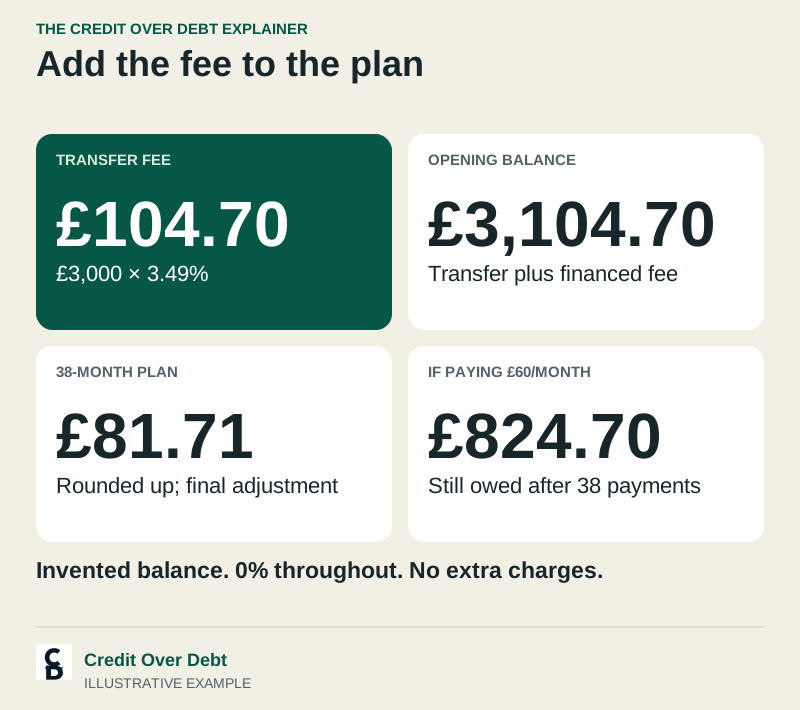
Read infographic as text
- Invented transferred balance £3,000; fee 3.49% gives £104.70.
- Opening balance is £3,104.70 including the fee.
- Divide by 38: £81.7026, rounded up to £81.71 with a final adjustment.
- At £60 for 38 payments, £824.70 remains. Assumes unchanged 0% throughout, no new spending, other charges or missed payments; not an individual offer.
Here is an illustrative calculation using an invented £3,000 transferred balance and the dated 3.49% fee. It assumes the fee is financed with the balance, the whole amount stays at 0% for 38 usable monthly payments, every payment arrives on time, and there are no new purchases or other charges.
The fee is £3,000 × 0.0349 = £104.70. Add it to the transferred amount to get an opening balance of £3,104.70. Divide by 38 and the result is about £81.7026 a month. Rounding upwards gives £81.71; the final payment would need adjusting to the remaining balance.
That figure is a planning payment, not the card's contractual minimum. Keep complying with the amount and date on each statement. Check whether the fee has different interest treatment in your actual terms; if it does, this simplified example needs changing.
Our transfer break-even guide answers the companion question: whether the fee is smaller than the interest avoided. Use the same payoff horizon on both sides. A transfer can save interest and still need a payment that does not fit your budget.
Test a shorter payoff window
Count the monthly payments genuinely available before your offer ends. If you choose a 30-month payoff plan for the illustrative £3,104.70 opening balance, the payment becomes £103.49. This is the same invented debt with less time to repay, not a second product quote.
Use a date you can monitor and leave space for a final balance check. Do not assume a future transfer will take over anything left. If you are comparing a hypothetical fee-free 24-month offer, label it hypothetical: £3,000 divided by 24 is £125 a month. That comparison shows a lower fee can require a higher monthly commitment; it does not establish that such an offer is available to you.
A paper worksheet works. Put the opening balance, usable months and planned payment on one line. Put the offer's actual end date directly below it, where it will be visible when you check a statement.
Look at what a weaker month leaves behind
Now reduce the payment in the invented 38-month example to £60. Over 38 payments, you would pay £2,280 and leave £824.70 from the £3,104.70 opening balance. This assumes unchanged 0% treatment and no extra charges. It demonstrates a remaining balance, not the interest that would be charged afterwards.
Use a payment supported by reliable money available after essential commitments. If a weak month would repeatedly reduce it, run the worksheet with that lower amount. The difference belongs in the decision before an application. Our minimum-payment explainer helps separate keeping up with a bill from clearing the balance.
MoneyHelper explains that transfer fees add to the balance, purchases can have different rates and transfer limits vary. It also warns against assuming another future deal will be available.
Do not call the expiry balance a saving
The £824.70 is still owed. It is not a fee, a new credit limit or an interest saving. A comparison sheet needs separate rows for interest avoided, transfer fee and balance remaining. Mixing them can make a plan look cheaper merely because less principal has been repaid.
For a fair comparison, set the same monthly payment and end date on both paths. If the old card remains interest-bearing, use its actual rate and the same payment timing. If the new card's post-offer rate or fee treatment is missing, stop the calculation at the documented boundary and identify what remains unknown.
You can use the paired repayment calculator to inspect those paths with manual inputs. It is an illustration, not a lender quote or a substitute for the minimum payment on your statement. Keep a paper copy of the assumptions if that is easier to check.
Keep the old and new balances visible
If only part of the balance transfers, use two lines: the amount on the new card and what remains on the old one. Include both payments in your calendar. Until the providers confirm what moved, keep tracking the old account rather than assuming it has been cleared.
Ask about any new spending before mixing it with the transfer. The clean illustrative worksheet above assumes none. Our APR and fees guide explains why total cost needs more than one advertised rate.
If the payment required to clear the balance does not fit, pause the application and ask the existing provider about support. Independent debt help through MoneyHelper is another route. Keep the actual fee, end date and repeatable payment together, then check the remaining balance on the worksheet before taking the next step.
From comparison to calculation
Check the terms in the offer you actually receive.
Credit Over Debt’s Offer X-Ray compares the amount financed, fees, payment schedule and modeled cost using the figures you enter.
Open the free toolkitPrimary sources and product pages
- TSB: Platinum balance transfer credit card (checked 2026-10-18)
- MoneyHelper: Transferring your credit card balance (checked 2026-10-18)
Product details last checked Oct 18, 2026; next scheduled review Nov 17, 2026. This UK-focused guide is educational information, not individualized financial, legal or tax advice. Product terms, offers and eligibility can change.