
The article addresses a reader decision using primary sources and clearly labelled illustrative examples. It does not rank every available product.
Commercial status: There are no affiliate links in this edition. Providers did not pay for inclusion or approve this copy.
On TransUnion's new UK 0–999 scale, 653 is the start of Good and 786 is the start of Excellent. Those boundaries classify a consumer display. They do not identify a lender's approval threshold or the price of an individual offer.
Use the table only after confirming that your service displays this version. When reviewing a report or considering credit, decide what weight this label deserves. A correct lookup answers one part of that decision; it does not answer the rest.
The current table has a defined scope

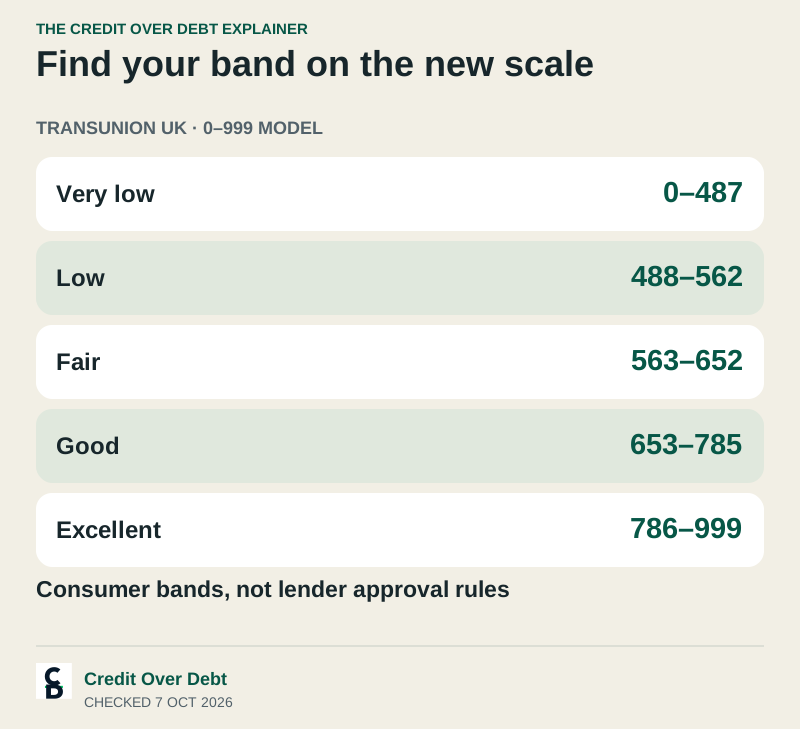
Read infographic as text
- Very low: 0–487.
- Low: 488–562.
- Fair: 563–652.
- Good: 653–785.
- Excellent: 786–999.
- These bands apply only to the new TransUnion UK 0–999 consumer model. They do not supply an approval threshold.
Read the band reference as a table
| Band | Inclusive range |
|---|---|
| Very low | 0–487 |
| Low | 488–562 |
| Fair | 563–652 |
| Good | 653–785 |
| Excellent | 786–999 |
The ranges include both endpoints. Every whole number from zero to 999 belongs to one row, with no gap or overlap. Do not apply this table to another bureau, another country or a TransUnion service that still identifies its maximum as 710.
For an illustrative lookup, a new-model score of 620 is Fair. A displayed 620 without the model information is incomplete evidence. Record the provider, bureau, maximum and date beside the number so a later comparison does not silently change its meaning.
A boundary changes a label, not a quoted offer

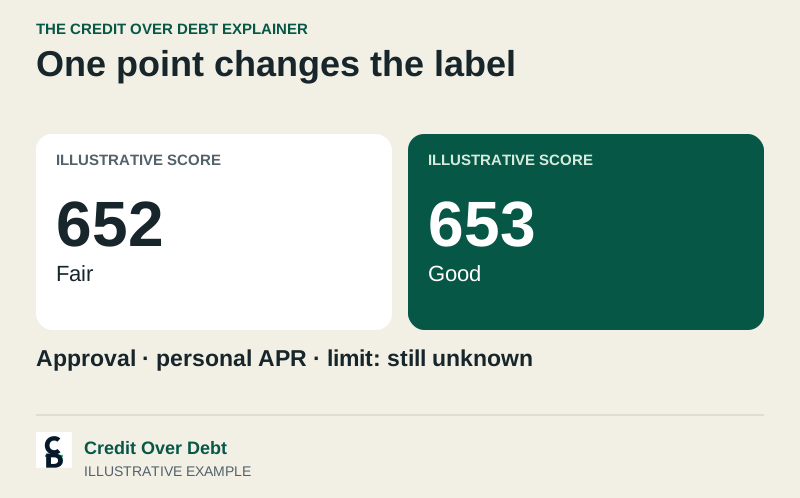
Read infographic as text
- Illustrative score 652 on the new scale: Fair.
- Illustrative score 653 on the new scale: Good.
- A one-point change crosses the label boundary. The band alone leaves approval, personal APR and limit unknown.
Consider another illustrative pair: 652 and 653. The second number crosses the Fair-to-Good boundary by one point. The table supports that classification and nothing further. It does not establish how a lender would weigh the two applicants, whether either would be accepted, or what either would pay.
That distinction matters when a marketing message treats the next band as a destination. Before taking an action to pursue the label, identify what problem the action is intended to solve. Correcting an inaccurate entry and making an unnecessary application are different decisions, even if both are presented as ways to improve a profile.
TransUnion says the consumer-score migration does not change the underlying report information. Lenders use that report with their own criteria. A favourable band is consequently insufficient evidence for a personal APR, limit or approval result.
Version differences need a version record
The 26 August announcement describes partner rollout from late September 2026 to June 2027. Its updated model considers patterns over time. This continuing transition explains why a lookup must identify the model; it is not evidence of a fresh launch today.
Keep old observations labelled as old rather than estimating their place on the new range. An old score divided by its maximum and multiplied by 999 would be your calculation, not a supplied new-model score. It could create a confident classification from an unsupported comparison.
Where two services disagree, first ask whether they display the same version and reporting date. If the answers match, the remaining difference still needs investigation; do not invent its cause. Save each answer so your record distinguishes provider information from your interpretation.
The report supplies questions you can verify
TransUnion's support guidance says lenders do not all report to every agency and recommends investigating unfamiliar or incorrect details. A missing account is therefore a question about reporting coverage before it is evidence of an error.
Make a small evidence list for entries you cannot reconcile. Include the creditor name, account reference, reporting period and supporting statement. Write the specific discrepancy in one sentence. Asking why an account shows an unfamiliar balance is a more answerable request than asking why your band is disappointing.
If the response leaves the discrepancy unresolved, retain it beside the original question. Our report-error dispute guide is useful for organising documents, while its rights and legal steps are US-focused. UK readers need the bureau's UK process rather than an imported deadline.
Compare the actual commitment separately
A band lookup can sit beside an offer comparison without controlling it. Record the amount needed, every disclosed fee, the payment frequency and the total repayment on the terms offered. Where a field is missing or only representative, mark it unconfirmed before assessing affordability.
The APR and fee guide helps organise those costs. For a card, our utilisation reference explainer shows why an educational benchmark needs scope. Its US context does not supply a universal rule for UK lenders.
A stronger label does not create more money for payments. If the documented commitment does not fit, waiting, saving for the purchase or reducing its size remain useful alternatives. You do not need a new credit agreement to respond to a changed consumer display.
Choose the question the table cannot answer
Confirm the scale and find its row. Then obtain the missing evidence relevant to your decision: an explanation of one report entry or the terms of an actual offer. Keep that answer with the lookup date. The band becomes useful when it frames a specific question rather than a promise about your next application.
From comparison to calculation
Check the terms in the offer you actually receive.
Credit Over Debt’s Offer X-Ray compares the amount financed, fees, payment schedule and modeled cost using the figures you enter.
Open the free toolkitPrimary sources and product pages
- TransUnion UK: The new TransUnion credit score explained (checked 2026-10-07)
- TransUnion UK: Launch of expanded 0–999 UK consumer score (checked 2026-10-07)
- TransUnion UK: Consumer support and credit-report FAQs (checked 2026-10-07)
Product details last checked Oct 7, 2026; next scheduled review Nov 6, 2026. This UK-focused guide is educational information, not individualized financial, legal or tax advice. Product terms, offers and eligibility can change.