
The article addresses a reader decision using primary sources and clearly labelled illustrative examples. It does not rank every available product.
Commercial status: There are no affiliate links in this edition. Providers did not pay for inclusion or approve this copy.
Amazon's UK Affirm options create different debts at the same checkout: a short interest-free plan and longer interest-bearing finance. The comparison with a credit card depends on the total repayment and the dates on your actual offer, rather than the size of its first payment.
Affirm announced the partnership on 23 September 2026. We rechecked the announcement on 18 October; its September rollout description does not establish access for every shopper today. This is a dated product comparison, not a new launch report or an endorsement.
The announcement is not your individual offer
Affirm's UK announcement describes eligible baskets from £50, plans spanning three to 48 months, 0% Pay-in-3 and longer finance at 22% representative fixed APR.
It describes availability expanding over the following weeks and excludes categories including gift cards, groceries, out-of-stock items and certain digital downloads. Eligibility and the options displayed at checkout remain conditions.
The longer plan carries interest. The 22% representative APR is an advertised comparison rate, not a personal approval or total-repayment promise.
Those facts establish the menu announced by the provider. They leave the reader's decision open: which option is actually offered for this basket, how much it costs, and whether each payment fits. Keep a copy of the terms shown before accepting. A saved offer is more useful for this comparison than a headline about the partnership.
Compare four repayment paths

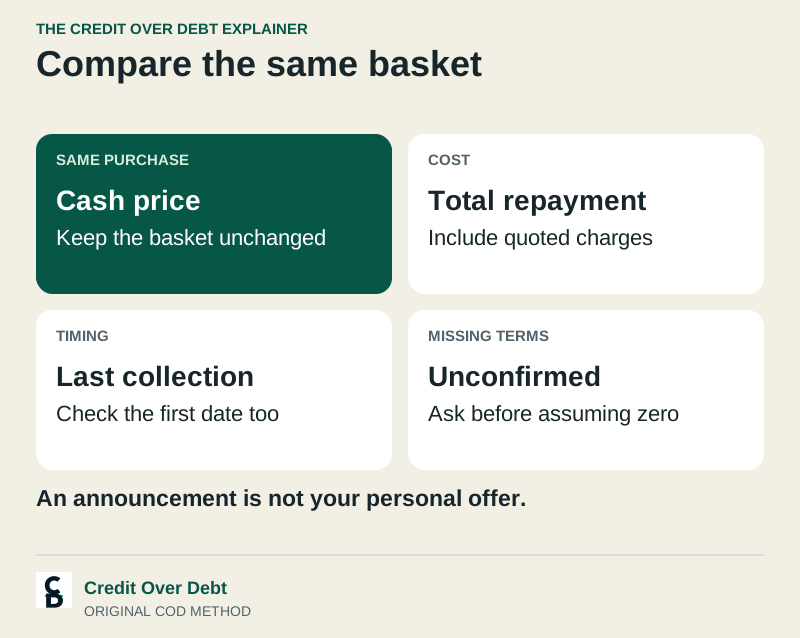
Read infographic as text
- Use one unchanged basket across all options.
- Record cash price and total repayment separately.
- Copy first and last collection dates from actual terms.
- Mark missing costs or interest conditions unconfirmed rather than assuming zero.
Use four rows in a comparison sheet: pay from available money, Pay-in-3, longer instalment finance, and an existing credit card. Add waiting as an alternative if none leaves room for essential commitments. Our original comparison method uses the same basket throughout, so an extra item added to reach a borrowing threshold cannot disappear from the cost calculation.
For paying now, record the cash price and the money left for already committed spending. For Pay-in-3, copy all amounts and dates, including the first collection. For longer finance, copy the term, total repayment and every charge shown. For the card, use its actual purchase terms and the date you intend to repay; record whether a balance is already being carried.
An existing card cleared in full can be a useful comparison only if the applicable interest-free terms are satisfied. Do not enter zero interest because that is how you usually use the card. If the terms or balance position are unclear, mark the cost unconfirmed and ask the issuer. Our statement and due-date guide helps distinguish the two dates you need.
A lower monthly payment can move the final collection further away while increasing the total paid. Conversely, paying from available money may reduce future commitments but leave too little for a bill due tomorrow. The sheet should expose both cost and timing, rather than making one number stand in for the whole decision.
Separate the order from the credit agreement
Keep two records for the same basket: the order summary and the finance offer. Put the lender's name and the offer date on the finance record. Then compare the amount financed with the items you actually intend to keep. Delivery charges, a changed basket or an item removed at checkout can leave you comparing different totals.
Before accepting, write the payment route and each collection date next to the available-money figure. A bank balance today is not the same as money free for a collection next month. If you cannot establish the final repayment from the displayed plan, leave that row incomplete and ask for the missing terms.
This also makes a later correction easier to describe. If an order changes, you can identify which order total changed and whether the lender has separately confirmed a revised balance. That is a record-keeping method, not a promise that a retailer's cancellation immediately closes the finance.
Put the dates beside existing commitments
Consider an illustrative £150 basket divided into three equal £50 payments. These invented amounts are a planning example, not an individual Affirm quote. If one £50 collection shares a period with £90 and £70 of existing commitments, that period contains £210 of payments. The new purchase contributes £50; the existing schedule explains the rest.
Repeat the exercise for each collection period. A comfortable first month does not establish that the third will fit. Our payment map provides a way to combine purchases without confusing the balance still owed with the amount leaving next week.
For a longer plan, use the lender's quoted total rather than reverse-engineering a repayment amount from the representative APR. Check the first and last dates against predictable income and large annual bills. If the purchase will be used briefly but paid for much longer, include that mismatch in the decision. It is a question about this purchase, not a claim that long finance is always unsuitable.
Keep the goods dispute and the finance record together
The FCA regulates covered third-party deferred-payment credit from 15 July 2026. The Ombudsman's BNPL route depends on a regulated firm, an agreement from that date and a provider-first complaint.
Do not infer a particular protection or successful remedy solely from the payment button. Ask which agreement and complaint route apply. This comparison does not decide Section 75 eligibility for an individual transaction. Save the order, lender identity, agreement and remedy instructions before you need them.
When a return is expected, keep its confirmation separate from any confirmed financing adjustment. Record both references and ask for clarification if the shop and lender show different balances. Do not treat a parcel sent back as proof that a payment has been cancelled. An unresolved adjustment belongs in the calendar until a change is confirmed.
Make the missing information part of the decision
After filling the sheet, circle each unresolved field. A missing total repayment, uncertain first collection or unclear card interest condition can change the comparison. Do not fill those gaps with assumptions drawn from a different product or an overseas version of the lender's website.
If the schedule needs another borrowing application to work, pause and test a smaller basket or waiting. If existing payments are difficult, seek provider support or independent debt help through MoneyHelper. Compare the final figures using our APR and fees guide. Keep one dated page containing the actual offer, total repayment, last payment date and unanswered questions; that page, rather than the announcement, should settle the next decision.
From comparison to calculation
Check the terms in the offer you actually receive.
Credit Over Debt’s Offer X-Ray compares the amount financed, fees, payment schedule and modeled cost using the figures you enter.
Open the free toolkitPrimary sources and product pages
- Affirm Holdings: Amazon and Affirm partner to offer UK customers new instalment options (checked 2026-10-18)
- Financial Conduct Authority: Regulating Buy Now Pay Later (checked 2026-10-18)
- Financial Ombudsman Service: BNPL complaints from 15 July (checked 2026-10-18)
Product details last checked Oct 18, 2026; next scheduled review Nov 17, 2026. This UK-focused guide is educational information, not individualized financial, legal or tax advice. Product terms, offers and eligibility can change.